 blog
7 SORA Certification Facts for Volunteer Security Roles
Last Updated: November 7, 2026
Quick Summary
SORA certification is worth it for volunteer security roles when your duties match security officer work, because New Jersey has no volunteer exemption and the law follows what you do, not what you are paid. If your role is greeting, setup, or first aid, the credential adds no authority and is hard to justify.
- Applicants must be at least 18, pass a background check, and complete the required training.
- Volunteers pay for training, the state application, fingerprinting, and renewal every two years.
- Observation and reporting to a registered officer generally is not security officer work; intervening is.
- Organizations needing registered security should sponsor a core team rather than make each volunteer pay.
- Registration starts with the 24-hour course, then the state application and fingerprints.
Table of Contents
- What the Security Officer Registration Act Requires of Volunteers
- NJ SORA Requirements for Security Guards: Who Actually Needs a License
- NJ SORA Training Hours: What the 24-Hour Course Covers
- NJ SORA License Cost: Fees, Fingerprinting, and Renewal
- Security Guard Certifications for Volunteers: SORA vs. Alternatives
- Volunteer Settings: Where SORA Helps and Where It Does Not
- Legal Boundaries and Liability for Unpaid Security Volunteers
- Registering for SORA Training Before Your First Volunteer Shift
- Frequently Asked Questions
What the Security Officer Registration Act Requires of Volunteers
Volunteers who want to work security at a community event, church, or neighborhood watch often ask whether SORA registration applies to unpaid roles. The Security Officer Registration Act applies to anyone performing security officer duties, whether or not the position pays. New Jersey does not carve out a volunteer exemption.
At Sora Center For Training, we provide training for first-time applicants and those needing re-certification.
The law focuses on what you do, not what you are paid. If your duties look like security work, registration applies.
NJ SORA Requirements for Security Guards: Who Actually Needs a License
You need a SORA license if you are employed or used as a security officer in New Jersey, and that includes unpaid roles that carry real security duties.
The New Jersey State Police SORA program sets the minimum qualifications. Applicants must be at least 18, pass a background check, and complete the required training.
Common volunteer situations that trigger the requirement:
- Church or temple safety teams with assigned security duties
- Community event gate and crowd control
- Neighborhood patrol groups with an organized command structure
- Volunteer positions at venues that classify the role as security
A volunteer handing out water bottles at a fun run is not a security officer. A volunteer guarding a parking lot entrance is. The duties decide it.
NJ SORA Training Hours: What the 24-Hour Course Covers
Training requirements for first-time applicants are set by the state, and Sora Center For Training offers the required training for first-time applicants. Confirm the current course requirements on the official state website.
If you are ready to start, you can book the SORA course with Sora Center For Training.
NJ SORA License Cost: Fees, Fingerprinting, and Renewal
The NJ SORA license cost has several parts, and volunteers often underestimate the total because they assume a free role means a free credential. You pay for training, the state application, fingerprinting, and renewal, none waived because you will not collect a security paycheck.
Fees vary by training provider and by the state's current schedule. For a full breakdown, see our guide to SORA license costs and fees.
- Training course: set by the training provider; this is usually the largest single line item and varies with class format and schedule
- State application fee: set by the state and paid when you submit your registration
- Fingerprinting: a separate vendor charge, collected at the time prints are taken
- Renewal: paid again every two years to keep the registration active
Check the state's official page for current amounts before you budget. A volunteer paying out of pocket should confirm every fee up front, including whether the provider bundles fingerprinting or charges it separately.
A cost-benefit framework for unpaid roles
Because the state does not publish a volunteer discount, compare total out-of-pocket cost against what the credential buys you in your specific role. Sort the decision into three buckets.
Bucket 1, Certification is legally required. If your duties match security officer work (checking IDs, controlling access, patrolling, responding to incidents), the cost is not optional.
Bucket 3, Certification is unlikely to pay off. If your role is greeting, ushering, setup, concessions, or first aid, the credential does not change what you are allowed to do and does not add authority you can use.
The renewal math volunteers forget
Renewal requires paying a fee again to keep the registration active. A volunteer who certifies for a single annual event and then lets the registration lapse has paid the full first-time cost for one season of use.
Watch out: some volunteer groups assume the organization's insurance covers unregistered helpers, then discover after an incident that the policy excludes security duties performed by uncertified people. Confirm coverage in writing.
Alternatives that cost less but do not replace SORA
If your goal is preparedness rather than legal security authority, lower-cost options exist: CPR and first aid certification, de-escalation training, and organization-specific emergency drills. These are worth the money for many volunteers, but none satisfies the registration requirement or grants security officer authority. Budget for them as complements, not substitutes.
Security Guard Certifications for Volunteers: SORA vs. Alternatives
Alternatives to SORA exist, but each one covers different ground.
| Option | What It Covers | Best For | Legal Security Authority |
|---|---|---|---|
| SORA registration | Full security officer duties | Volunteers doing real security work | Yes |
| CPR and first aid | Medical response | All volunteers | No |
| De-escalation training | Conflict management | Greeters, ushers | No |
| Emergency response drills | Fire, evacuation | Event staff | No |
A CPR card does not make you a security officer. Neither does a de-escalation certificate. Those skills help, but they do not satisfy the registration requirement.
One question we hear often: can a SORA holder carry a firearm on a volunteer shift? That requires separate permits and an armed security endorsement. Our article on carrying a firearm with a SORA license explains the limits.
Volunteer Settings: Where SORA Helps and Where It Does Not
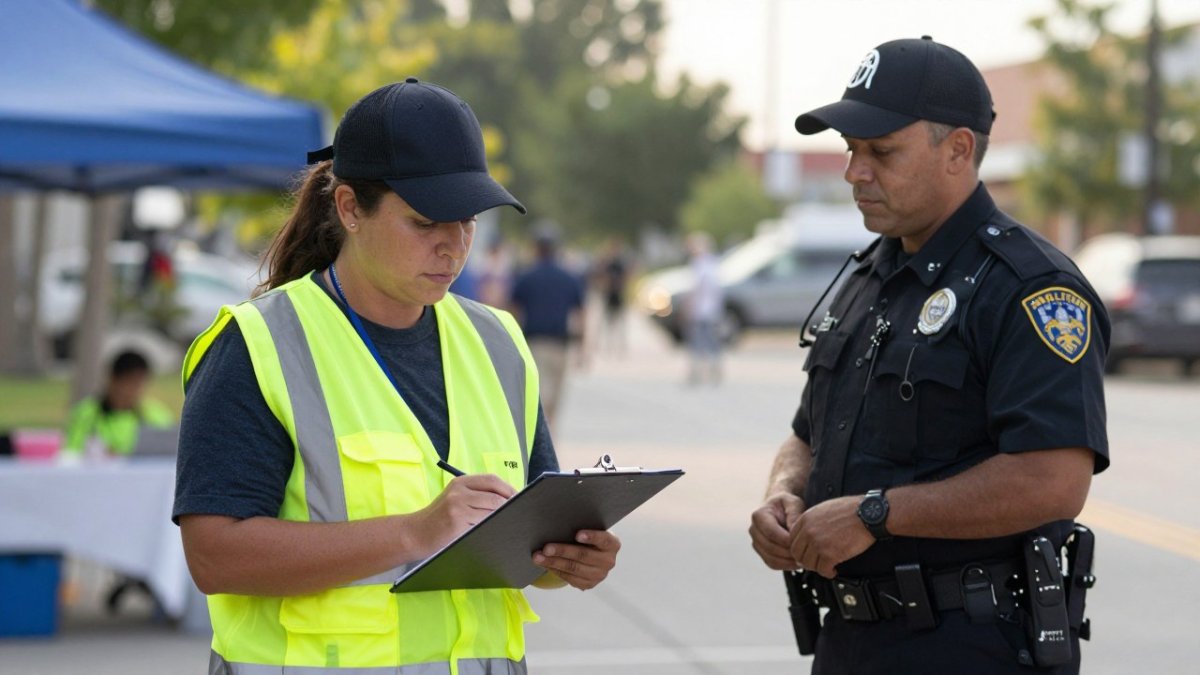
SORA helps in any volunteer role where you are actually performing security duties. It does not help, and is not required, where the role is hospitality, setup, or general event support. The hard part is that the same event can contain both kinds of roles, and organizers often blur them.
Role-by-role guidance for common volunteer settings
Community festivals and fairs. Gate control, crowd management, and incident response are security duties. Ticket takers, concession workers, and cleanup crews are not.
Neighborhood patrols. An organized group with a command structure, assigned routes, and a security mission is performing security work.
Youth sports complexes. Parking and field security assigned to a volunteer is security work. Field marshaling, scorekeeping, and snack-bar duty are not.
Event medical and first aid stations. First aid volunteers are providing medical response, not security.
A decision checklist for your actual duties
Before you enroll in a course, run your role through these questions. If you answer yes to the first group, registration is likely required. If you answer yes only to the second group, it likely is not.
Duties that point toward required registration:
- Do you have an assigned post with responsibility for protecting people or property?
- Are you expected to check IDs, control access, or patrol a defined area?
- Are you expected to respond to incidents, restrain, or detain anyone?
- Does the organization describe your role as security in its planning documents?
Duties that point away from required registration:
- Is your role primarily greeting, ushering, or hospitality?
- Are you handling setup, cleanup, concessions, or registration tables?
- Is your only safety responsibility to observe and report to a designated security lead?
- Are you providing medical care rather than protective services?
The observation-versus-enforcement distinction
The cleanest dividing line most practitioners use is observation versus enforcement. A volunteer whose job is to notice problems and report them to a registered officer or to police is generally not performing security officer duties. A volunteer whose job is to intervene, stop someone, search a bag, hold a door, or remove a person, is performing security work and should be registered.
Watch out: a role description that says "assist security" is ambiguous and often gets interpreted by volunteers as authority to intervene. Rewrite it to specify exactly what the volunteer may and may not do.
When the organization should carry the registration
If an organization genuinely needs registered security at its events, the cleanest structure is for the organization to sponsor registration for a core team rather than asking each volunteer to pay out of pocket. That concentrates the cost on the people who will actually use the credential across many events and gives the organization a documented roster it can show its insurer. Volunteers asked to certify for a single event should push back and ask why the role cannot be restructured as observation and reporting instead.
Legal Boundaries and Liability for Unpaid Security Volunteers
Liability is the angle most volunteer groups miss. An unpaid volunteer who acts like a security officer without registration creates risk for themselves and for the organization that placed them there.
The law does not excuse unregistered security work because the worker was not paid. An organization that assigns security duties to an unregistered volunteer can face exposure if something goes wrong.
Practical safeguards:
- Define duties in writing before the event
- Keep unregistered volunteers out of enforcement roles
- Confirm registration status for anyone doing security work
- Document who is assigned to what
The background check requirement exists for a reason. Our guide to SORA background check requirements covers what the state reviews and what can disqualify an applicant.
Registering for SORA Training Before Your First Volunteer Shift
Registration starts with training, not with the state application. You complete the 24-hour course through an authorized provider, then submit your application and fingerprints.
The steps in order:
- Confirm you meet the age and eligibility rules
- Enroll in a 24-hour course with an authorized provider
- Complete the training and pass the course
- Submit your application to the state
- Get fingerprinted
- Receive your registration card
Timing varies by how fast the state processes your application and how quickly you finish the course. Start early if your volunteer shift has a fixed date.
If you are unsure how to enroll, our step-by-step SORA registration guide walks through each screen.
Volunteer security work carries real duties and real legal weight, and the registration requirement follows the duties, not the paycheck. If your role involves protecting people or property, get registered before your first shift.
Frequently Asked Questions
Do volunteer security guards in New Jersey need SORA certification?
It depends on what the role actually involves. New Jersey's Security Officer Registration Act applies to people who perform security officer duties. If your volunteer work is purely internal to a house of worship, nonprofit, or community group and you are not acting as a contracted security officer, SORA may not be legally required. The moment you take on enforcement-style duties, wear a uniform, or work through a licensed company, the NJ SORA requirements for security guards usually apply. Confirm your specific situation with the New Jersey State Police before your first shift.
Is SORA certification worth the cost if you only volunteer?
Run the numbers against what you get back. The NJ SORA license involves costs for training, the state application, and fingerprinting, along with renewal. For current prices, contact Sora Center For Training. If the volunteer role is occasional and strictly internal, the math rarely works in your favor. If you plan to move into paid security work, the certification pays for itself once you land a paid post, since many employers look for SORA-licensed applicants. For volunteers who want a career path, treat the cost as a career investment rather than a volunteer expense.
How long does it take to complete NJ SORA training and registration?
Plan ahead, since processing time varies. Training schedules vary, and you should confirm session options directly with Sora Center For Training. After the course, you submit the application, complete fingerprinting, and pass the background check. Processing time varies, so start the process well before a volunteer event rather than the week of. Ask your training provider whether they walk you through the application step by step.
What other security guard certifications are useful for volunteer roles?
Beyond SORA, volunteers often benefit from CPR and first aid certification, basic crowd management training, and de-escalation courses. Stop the Bleed and FEMA's free incident command courses are low-cost ways to build practical skills for event and property protection work. None of these replace SORA if your duties legally require it, but they strengthen your readiness and look good on a resume if you later apply for paid security jobs. Choose certifications that match the settings you actually volunteer in.