 how-to
Can You Carry a Firearm With a SORA License
Last Updated: November 1, 2026
Quick Summary
No, a SORA license does not let you carry a firearm in New Jersey. A SORA license is a registration card that allows you to work as a security officer, not a carry permit. Armed SORA status only permits carrying a firearm while on a specific authorized armed post.
- A New Jersey carry permit is a separate credential with its own application, review and standards.
- Armed status requires a current SORA registration, armed training, employer sponsorship and an authorized post.
- Armed status follows the authorized post, not the person, so it does not travel with you.
- Carry your registration card, photo ID and armed qualification record on every shift.
- Working a shift with a lapsed registration can get you pulled off the post and expose your employer.
Table of Contents
- The Short Answer on Carrying a Firearm With a SORA License
- SORA License vs Carry Permit in New Jersey
- New Jersey SORA Armed License Requirements
- New Jersey Armed Security Guard Firearm Training
- Step-by-Step: Becoming Eligible to Carry While Working Security
- Where and When Armed Officers May Carry, Including Off-Duty Limits
- Credentials to Carry and What Happens When They Expire
- Start Your SORA Training With an Authorized Provider
- Frequently Asked Questions
The Short Answer on Carrying a Firearm With a SORA License
No. A SORA license does not let you carry a firearm in New Jersey. The SORA license is a registration card that allows you to work as a security officer. It is not a carry permit.
That single fact trips up a lot of new officers. Many people assume that an armed security job comes with the right to carry. It does not.
Here is the short version:
- SORA registration = permission to work as a security officer
- Armed SORA status = permission to carry a firearm while on a specific armed post
- Carry permit = a separate credential from the state, with its own application and background check
Below, we break down exactly how these pieces fit together, what the armed requirements look like, and the steps to become eligible to carry while working security.
SORA License vs Carry Permit in New Jersey
A SORA license and a New Jersey carry permit are two different credentials with two different purposes. The SORA card proves you are registered to work in security. A permit to carry proves the state has approved you to carry a handgun.
Confusing the two is the most common mistake we see. For a broader overview of how New Jersey security licensing works, see our Beginner's Guide to NJ Security Licensing. The confusion is understandable, since both involve the state police and both involve a background check. But they are issued under different rules and serve different roles.
What the SORA Registration Actually Covers
SORA registration is the state's record that you have met the basic requirements to work as a security officer. Registration requirements are set by state law. Registration generally covers:
- Your identity and background check
- Completion of the required training course
- Your status as an unarmed or armed officer
The registration card is what you show an employer to prove you can legally work. It does not mention firearms unless you hold armed status. And even armed status is tied to your job, not to your personal life.
What a New Jersey Carry Permit Covers
A New Jersey concealed carry permit is a separate approval that lets you carry a handgun for personal protection. It has its own application, its own review, and its own standards. The state police and local authorities handle that process.
Holding a carry permit does not make you an armed security officer. And holding armed SORA status does not give you a carry permit. The two run on parallel tracks. You can hold one, both, or neither.
Here is how the two credentials differ at a glance.
| Credential | What it proves | Key limit |
|---|---|---|
| SORA registration | Registered to work as a security officer | Not a carry permit |
| Armed SORA status | Permission to carry a firearm while on a specific armed post | Tied to the authorized post, not the person |
| New Jersey carry permit | State approval to carry a handgun for personal protection | Does not make you an armed security officer |
New Jersey SORA Armed License Requirements
Armed security officer status is not a separate license you apply for on your own. It is a designation added to your SORA registration after you meet additional training and employment conditions.
The Four Things That Must Line Up
To work an armed post, all four of these must be true at the same time:
- You hold a current SORA registration. The Security Officer Registration Act registration is the foundation. Without it, no armed designation is possible.
- You have completed the armed-officer training and firearms qualification. This is separate from the basic SORA course and is delivered by an approved instructor.
- A licensed security employer sponsors you for an armed position. Armed status is tied to employment. You cannot self-designate as armed.
- The post itself is authorized for an armed officer. Your employer must have an armed contract, and you must be assigned to it.
If any one of those four falls away, your registration lapses, your employer loses the armed contract, you change jobs, your authority to carry on the job changes with it.
Who Approves Armed Status
Confirm the current armed-officer approval process with the New Jersey State Police and your employer, since the responsibilities for registration, training and assignment are set by state rules and employer policy.
What the Firearms Qualification Actually Involves
Armed-officer firearms training typically covers several components. Check the requirements with your training provider and the state. Commonly included topics are:
- A written or classroom component on use-of-force law and safe handling
- A live-fire course of fire with a required passing score
- Weapon retention, drawing, and holster work
- Malfunction drills and reloading under time pressure
- A signed qualification record from the instructor
Keep a copy of any qualification record you receive.
How Armed Status Is Tied to Your Employment
Your employer must hold the armed contract and assign you to it. That means:
- You cannot pick up an armed shift for a company that has not sponsored you.
- If your employer's armed contract ends, your armed assignment ends with it.
This is the detail most guides skip. Armed status feels like a personal credential, but it functions like a job-specific authorization. Treat it that way and you will avoid the most common compliance trap.
New Jersey Armed Security Guard Firearm Training
Firearms training for armed officers covers more than marksmanship and can include legal rules on use of force and safe handling. Check current state requirements for qualification.
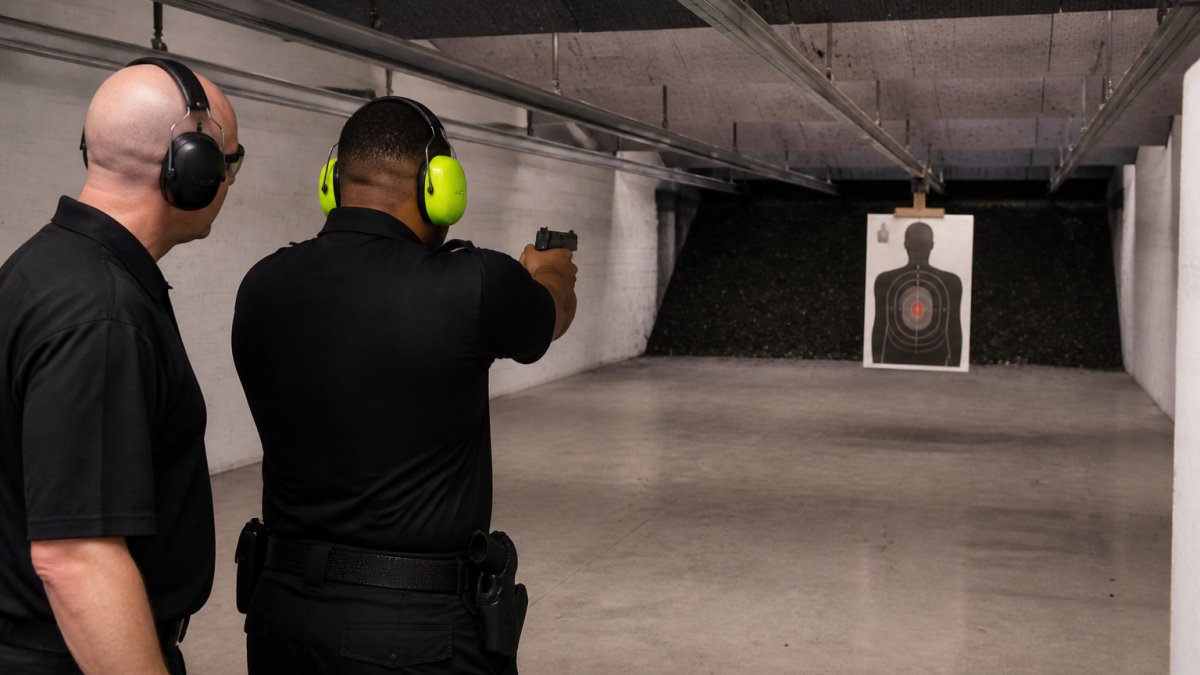
Training content varies by provider. Confirm with your training provider what is covered.
Step-by-Step: Becoming Eligible to Carry While Working Security
Becoming eligible to carry while working security involves several steps. The general sequence is:
- Complete the basic SORA course. Finish the required training with an authorized provider.
- Submit your registration application. File with the state police and pass the background check.
- Get hired by a licensed security employer. Employer sponsorship is part of the process.
- Ask your employer about armed posts. Confirm whether armed positions are available.
- Complete armed firearms training. Finish any additional instruction and qualification required.
- Pass the qualification. Meet the applicable state standard.
- Carry your credentials on every shift. Keep your registration card and any armed documentation with you.
Where and When Armed Officers May Carry, Including Off-Duty Limits
Armed officers carry a duty firearm only as authorized by state law and their employer's rules. Confirm current carry rules with the New Jersey State Police.
This is where new officers get into trouble. A few rules to keep straight:
- Carry only the firearm your employer authorizes
- Follow your employer's holster and storage rules
- Confirm current state rules before carrying off duty
Personal carry outside of work is governed by separate rules; confirm current requirements with the New Jersey State Police.
Credentials to Carry and What Happens When They Expire
Carry a current registration card, photo identification, and proof of armed qualification on each shift. Knowing what happens when a document lapses is also important.
The Duty-Bag Checklist
Keep these with you on every shift, not in your car and not at home:
- Current SORA registration card
- Valid government-issued photo ID
- Armed qualification record signed by your instructor
- Employer-issued badge or identification
- Any post-specific authorization your employer requires
- A copy of your employer's current armed-post assignment letter, if they issue one
What Happens When a Credential Expires
The consequences are not uniform, they depend on which document lapsed and whether you were on duty when it happened.
- Expired SORA registration. Working a shift with a lapsed registration is not a paperwork slip. If your credential has already lapsed, our Renew Expired SORA License: Step-by-Step Guide walks you through the renewal process. It can get you pulled off the post, create problems with your employer, and expose you to state-level consequences. Your employer is also exposed for assigning an unregistered officer.
- Lapsed armed qualification. If your qualification record is not current, confirm with your employer and the state whether you may work an armed post.
- Missing photo ID or badge. Employers may require these items as a matter of policy.
- Lost card. Report it to your employer and follow the applicable state replacement process.
Renewal Mechanics You Should Know
Registration and training records have renewal timelines, and the rules can change. Confirm the current renewal window directly with the New Jersey State Police and with your employer before your card is close to expiring.
A practical pattern that works for most officers:
- Note the expiration date on every credential the day you receive it.
- Set a reminder well before expiration.
- Confirm the current renewal requirements with the state police and your employer.
- Complete any required refresher training before the deadline, not after.
- Keep the new documents in your duty bag and update your phone photos.
Start Your SORA Training With an Authorized Provider
The fastest way to get this right is to train with a provider the state police recognize. Sora Center For Training is an authorized SORA training provider. We offer training for first-time applicants and for officers needing re-certification, and we provide guidance on mandatory New Jersey State Police registration.
Our programs include:
- SORA training for first-time applicants
- Re-certification for licensed security guards
- Guidance on mandatory New Jersey State Police registration
Frequently Asked Questions
Can you carry a firearm with a SORA license in New Jersey?
No. A SORA registration card identifies you as a registered security officer, but it does not authorize firearm carry on its own. Confirm current New Jersey requirements for carrying a firearm while working with the New Jersey State Police.
Does a SORA license authorize you to carry a gun off duty?
Off-duty carry is governed by state rules, not your SORA registration. Check current New Jersey State Police guidance before carrying off duty.
What training is needed for a New Jersey SORA armed license?
Armed officers may need firearms training and qualification beyond the initial SORA course. Confirm the current requirements, including any qualification standard, with your training provider and the state, since requirements can change.
What is the difference between a SORA license and a New Jersey carry permit?
A SORA license registers you to work as a security officer. A New Jersey permit to carry a handgun is a separate credential issued through the state's permitting process. Confirm current requirements for each credential with the New Jersey State Police.
The difference between a SORA card and a carry permit is the difference between a job and a legal problem. Get the training right, keep your credentials current, and know the limits of what your card allows. Get started with Sora Center For Training and complete your SORA requirements with an authorized provider.