 how-to
NJ Security Guard License Processing Time: Complete Timeline
Table of Contents
- How Long Does NJ Security Guard License Processing Actually Take?
- Understanding the NJ SORA Application Process and Its Timeline
- Checking Your NJ SORA Application Status
- NJ SORA Fingerprinting and Background Checks
- NJ SORA Renewal Processing Time and Requirements
- What Delays NJ SORA Processing and How to Avoid Them
- Can You Work While Your License Application Is Processing?
- Frequently Asked Questions
Last Updated: October 20, 2026
How Long Does NJ Security Guard License Processing Actually Take?
The nj security guard license processing time is one of the most common questions we hear from first-time applicants. Most expect a straightforward answer, but processing time depends on which stage you're asking about: your own work, the state's review, or the full timeline.
Here's the reality: the total time can range from 30 days to several months, depending on how quickly you complete your steps and how backed up the New Jersey State Police processing queue is. The state's part alone typically takes 4-8 weeks after you submit your complete application. But the clock starts ticking before that, when you enroll in training.
At Sora Center For Training, we guide applicants through this entire process. Understanding the actual timeline helps you plan your job search and avoid costly mistakes.
The key insight most guides miss: your processing time and the state's processing time are two different clocks. You control one; the state controls the other.
Understanding the NJ SORA Application Process and Its Timeline
The Security Officer Registration Act (SORA) process is best understood as two clocks running at different speeds: the applicant clock (training, fingerprinting, paperwork) and the state clock (review, background adjudication, card issuance). Here is the separation, with realistic milestone windows.
Applicant-Controlled Clock (typically 3-6 weeks)
- Week 0-1: Register and enroll. Create your account in the New Jersey State Police SORA application portal, confirm your identity, and enroll in a state-approved 24-hour security officer training course. Course seats fill faster in late summer and around the new year; booking two to three weeks out is common.
- Week 1-4: Complete the 24-hour course. Full-time students finish in roughly two weeks; evening and weekend students typically take three to four. You cannot fingerprint until you have your training completion documentation in hand, so this step gates everything downstream.
- Week 3-5: Fingerprinting. Schedule an appointment through the state's authorized fingerprint vendor (IdentoGO is the vendor most applicants use). Appointment availability swings from same-week to two-to-three weeks out depending on the site. The appointment itself takes 10-15 minutes.
- Week 4-6: Submit the complete application. Upload your training certificate, fingerprint confirmation, sworn statement, and identification. This is the moment the state clock starts.
State-Controlled Clock (typically 4-8 weeks, sometimes longer)
Once the New Jersey State Police receives a complete application, the review sequence is: verify training completion with the provider, adjudicate the fingerprint-based criminal history check, confirm identity and sworn statement, then issue the certification card.
What Happens During State Review
The state verifies training completion with your provider, cross-checks fingerprint results against state and federal databases, confirms your identity, and reviews your sworn statement. If anything is missing or inconsistent, the application is flagged and the clock effectively restarts once you respond.
Temporary Certification: The 30-Day Bridge
A key mechanism many applicants miss: once your complete application is received, you receive a temporary certification that allows you to work while the state finishes its review. It is valid for 30 days.
Checking Your NJ SORA Application Status
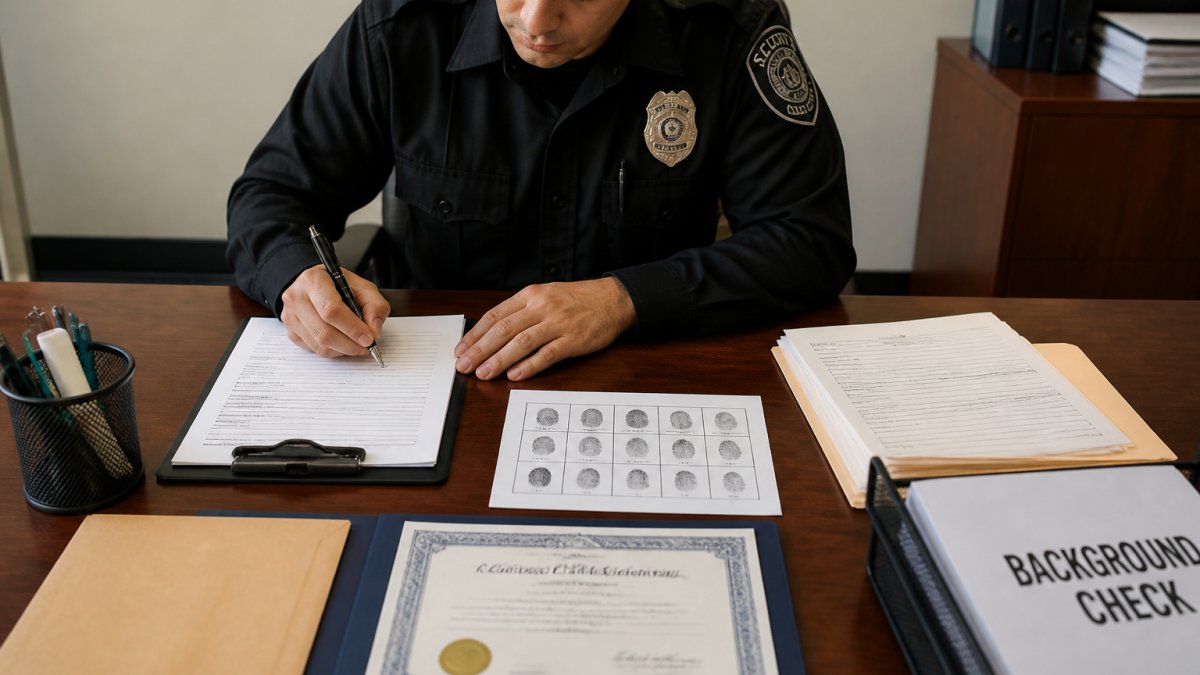
You can track your nj security guard license processing time by monitoring your application status through the official New Jersey State Police portal. Log in with your credentials; your status will show one of these stages:
- Application received and under review
- Fingerprints verified
- Background check complete
- Temporary certification issued
- Final approval pending
- Certification approved and mailed
If your application has been "under review" for more than 8 weeks, contact the New Jersey State Police with your application number and ask for an estimated completion date. Applications often get stuck on incomplete documentation or a missing signature, and a quick call resolves it. Document everything, screenshot your status page and save confirmation emails, so you have proof of when you submitted and followed up.
NJ SORA Fingerprinting and Background Checks
Fingerprinting is a required step, and it's often where applicants lose time without realizing it. Schedule an appointment at an authorized location, New Jersey State Police stations, some local police departments, or authorized fingerprinting service centers. Availability varies by location and season: busy months mean 2-3 weeks for an opening, slower months within days.
Call ahead to multiple locations and ask about wait times. Some stations have shorter queues. Don't just book the closest one. A longer drive can save weeks.
The fingerprinting itself takes 10-15 minutes, and you pay a small fee. Keep your receipt, you'll need proof of completion when you submit your application. The background check then runs automatically: the state searches its criminal database, federal records, and sex offender registries, typically taking 1-2 weeks. You don't have to do anything during this time.
NJ SORA Renewal Processing Time and Requirements
If your security guard license is expiring or has already expired, renewal follows a different timeline than initial certification.
For renewal, complete an annual refresher course before your certification expires, typically 4-8 hours depending on your provider. Start at least 4-6 weeks before your expiration date to avoid a lapse.
After the refresher, submit your renewal application. Renewal processing is usually faster than initial certification, typically 2-4 weeks. The state doesn't re-fingerprint you or run a new background check unless something in your record has changed; it verifies training completion and issues your renewal.
Your renewal certification is valid for two years from approval. Mark your calendar, many applicants let their certification lapse and can't legally work until they renew.
What Delays NJ SORA Processing and How to Avoid Them
Most delays fall into four buckets. Each has a prevention step and a fix, and knowing which bucket you are in tells you whether to wait, resubmit, or call the state.
1. Incomplete or inconsistent applications (most common)
Missing signatures, an undated sworn statement, a name that does not match your identification exactly, or a training certificate uploaded to the wrong field will get your application returned.
- Prevent: Before submitting, read every field aloud against your ID and training certificate. Have a second person check signatures and dates. Confirm your name matches your government ID character-for-character, including middle names and suffixes.
- Fix: Respond to the state's notice the same day, correct only what was flagged, and keep a screenshot of the resubmission confirmation.
2. Training documentation gaps
Your application needs proof of the 24-hour course. Some providers issue certificates on a delay, and a certificate with a typo in your name creates a mismatch the state will flag.
- Prevent: Ask your provider, before the course ends, exactly what document you will receive, in what format, and when. Verify your name and course hours on the certificate the moment you receive it.
- Fix: Request a corrected certificate in writing and keep the email thread; you may need it to show the state why a document was resubmitted.
3. Fingerprint rejection or appointment scarcity
Poor print quality, dry skin, recent lotion, calluses, or smudging, can cause a rejection and a required reprint, adding one to three weeks.
- Prevent: Arrive with clean, dry hands and no lotion. Ask the technician to confirm print quality before you leave. When booking, check two or three fingerprint sites rather than only the closest one; a longer drive can save weeks.
- Fix: If rejected, rebook immediately and bring your original receipt so you are not charged twice for the same requirement.
4. State queue and follow-up lag
This bucket is outside your control, but your response to it is not.
- Prevent: Submit as early as your documents allow, monitor the email address on your application daily (including spam), and log in to the portal weekly.
- Fix: If your status has not moved in more than eight weeks, contact the New Jersey State Police SORA unit with your application number, submission date, and a one-line summary of what you are asking (status check or estimated completion). A short, specific message gets a faster response than a long one.
Status Tracking and Escalation: What to Have Ready
What You Can Do While Waiting
You can work under your temporary certification for its 30-day window, and you can request an extension if final approval has not arrived.
Official New Jersey State Police SORA application and status portal
Can You Work While Your License Application Is Processing?
Yes, and it changes your financial situation entirely. Once you receive your temporary certification, you can legally work as a security guard for 30 days.
Your temporary certification is issued automatically once your application is received by the state. It's valid for 30 days from the date of issue. During this window, you have full authorization to work.
If your permanent certification hasn't been approved by day 30, request an extension from the New Jersey State Police. They typically grant one 30-day extension, giving you 60 days total to work while the state completes its review.
This is why understanding the nj security guard license processing time matters: you're not unemployed for months, just working on a temporary basis while the permanent paperwork processes. Most applicants don't take advantage of this, and it costs them money.
The timeline from training to permanent certification typically spans 8-16 weeks, but your earning potential starts when you receive your temporary credential.
At Sora Center For Training, we make sure you understand each deadline and stage. We provide state-satisfying training and guide you through the application. Your success depends on clear information and timely action.
Frequently Asked Questions
How long does the complete NJ security guard license processing time take from start to finish?
The full timeline depends on your path. First-time applicants typically complete the 24-hour mandatory security officer training within 1-3 weeks, then submit their application. State processing of your application and background check generally takes 2-4 weeks after submission. The 30-day temporary certification allows you to begin working immediately while permanent approval is underway. Total elapsed time from starting training to receiving your permanent certification card is typically 6-8 weeks, though this varies based on application completeness and fingerprinting appointment availability.
What should I do if my NJ SORA application status shows no updates for several weeks?
First, verify your application was submitted successfully through the official application portal and confirm receipt. Check that all required documents were included and that your fingerprinting appointment was completed. If you submitted 4+ weeks ago and see no progress, contact the New Jersey State Police directly for clarification. Common causes of delays include incomplete applications, missing identity verification documents, or fingerprint quality issues.
Can I work as a temporary security guard while waiting for my permanent NJ SORA license?
Yes. Once you complete the required 24-hour security officer training and submit your application, you receive a 30-day temporary certification that authorizes you to work immediately. This 30-day period gives you temporary work authorization while the state processes your permanent certification. However, you must complete your fingerprinting appointment and background check during this window. Your temporary certification expires after 30 days, so your permanent approval must be finalized before that date to continue working without interruption.
How long does NJ SORA renewal processing take for security guards renewing their license?
Renewal processing is typically faster than initial certification. Once you submit your renewal application along with proof of completing the annual refresher training course, state processing usually takes 1-3 weeks. Unlike first-time applicants, renewals do not require a new background check or fingerprinting unless specifically requested. However, processing time can vary based on state workload and application completeness. Submitting your renewal well before your current two-year certification expires prevents work authorization gaps.